


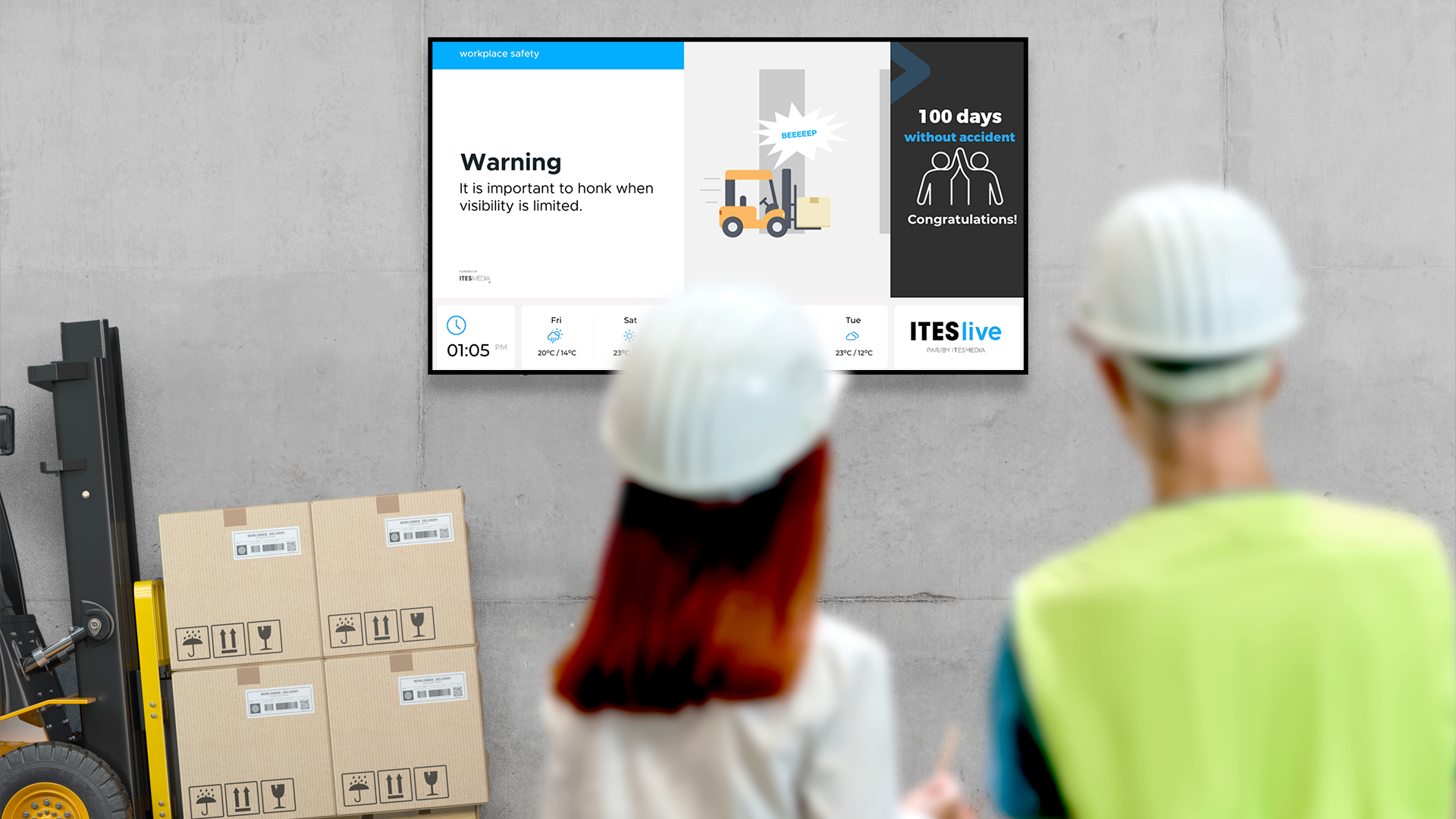
Digital signage in warehouses and industrial sites makes it possible to quickly disseminate safety information, performance metrics, and internal communications to employees who are often far from computers. When placed in the right locations and fed with relevant content, digital displays can support safety, employee engagement, and operational efficiency.
Where should digital signage screens be installed in a warehouse?
Digital signage screens should be installed in areas where employees regularly pass through or stop, such as entrances, locker rooms, time clocks, production lines, order-picking areas, loading docks, and break rooms. The choice of location should take into account employees’ exposure time and attention levels in each area.
How should content be tailored based on the screen’s location?
The first step is to think in terms of key areas and times. Map out employees’ movements within your facility: entrances, locker rooms, time clocks, production lines, order-picking areas, loading docks, and break rooms. Each area has different downtime periods and attention levels. For example, a badge-based time clock station can provide a predictable 30- to 60-second window during which employees can review a brief safety reminder or a key point about their shift, whereas a break room is ideal for sharing more detailed content, such as training overviews or recognition stories.
Use this mapping to determine where to install the screens and what role each one should play. Near entrances and time clocks, prioritize safety messages, shift-specific announcements, and general performance summaries. On the production floor or in order-picking aisles, focus on key performance indicators (KPIs) and simple, visual process reminders that can be understood at a glance. In break rooms and cafeterias, expand the content to include HR news, wellness tips, and messages of recognition.
Next, align your content strategy with existing processes. Coordinate messages with daily meetings or shift changes so supervisors can refer to the content displayed on screen during their discussions. If your organization already uses visual management boards or whiteboards, consider replacing or supplementing them with digital screens directly connected to your data sources.
What Types of Content Should You Prioritize?
Once the right screens are installed in the right locations, the next challenge is to populate them with content that employees actually notice and that motivates them to take action. In industrial environments, this means focusing on three pillars: safety, engagement, and recognition.
Safety-related content should always be a priority. Prioritize high-contrast templates and clear pictograms to effectively communicate essential information, such as lockout/tagout reminders, near-miss alerts, personal protective equipment (PPE) requirements, and emergency procedures. Use simple, direct language, and avoid overloading messages with secondary details. Full-screen displays should be reserved for urgent situations requiring immediate action, such as chemical spills, extreme weather conditions, or safety incidents.
To facilitate the creation of this type of content, the ITESlive software offers several ready-to-use images and templates, designed according to best practices in digital signage. This allows internal teams to quickly create and distribute clear, professional communications without having to design each piece of content from scratch.
Beyond safety, digital signage can help focus attention on operational goals. Display real-time KPIs from your warehouse management system (WMS) or manufacturing execution system (MES): number of orders picked per hour, on-time shipments, downtime by cause, or quality metrics. When employees see their team’s performance in near real time, they are more likely to proactively adjust their behavior.
Recognition content complements this approach by highlighting the people behind the numbers. Use screens in break rooms and near time clocks to highlight incident-free periods, completed training, and recognition nominations submitted by colleagues.
How can you measure the impact and improve the strategy over time?
To measure the impact of digital signage in a warehouse or industrial facilities, start by setting clear, measurable goals, such as reducing safety incidents, improving training outcomes, increasing productivity, or boosting employee engagement. Next, compare relevant metrics before and after running your campaigns to identify the most effective messages and placements.
Complement this data with simple tools, such as QR codes to track interactions, short employee surveys, or feedback from supervisors and health and safety managers. This information helps assess whether the messages are being seen, understood, and found useful.
Finally, use the results to adjust the content, its frequency of display, and the placement of the screens. This continuous improvement allows you to tailor your digital signage strategy to the actual needs of employees and the evolving nature of your operations.
In conclusion, to be effective in a warehouse or industrial site, digital signage must combine the right location, the right content, and the right timing. By tailoring messages to different work areas and regularly measuring their impact, organizations can improve internal communication, enhance safety, and support operational performance. With a solution like ITESlive, this strategy can be centralized and easily adapted to the needs of each site, team, or shift.
SUBSCRIBE TO OUR NEWSLETTER
Stay connected on the latest dynamic digital signage news and get tips for successful signage