A digital signage strategy allows you to plan content, screen locations, and broadcast schedules so you can deliver the right messages to the right people at the right time. It’s much more than just content planning, as it forms the foundation of an effective digital signage network.
Without a strategy, screens risk displaying messages that are irrelevant or ill-suited to their audience. Conversely, a well-defined strategy improves visual communication, fosters audience engagement, and maximizes the return on investment for your digital signage solution.
What is a digital signage strategy?
A digital signage strategy is a plan that defines how your organization will use its network of screens to achieve specific communication objectives.
The content strategy involves determining what content will be displayed, on which screens, at what times, and to which audiences. It also helps define how information will be presented based on screen location, different display zones, the target audience, and the context of the display.
This step also helps identify the best locations to install screens in order to optimize their visibility and impact. For example, a screen installed outside a building generally does not serve the same purposes as a screen located in a lobby, waiting room, or cafeteria. Adapting the content and screen locations to their environment is essential for maximizing the effectiveness of your digital signage strategy.
Contrary to popular belief, the success of a digital signage project depends far more on the quality of the strategy than on the number of screens or the software used. Even with a high-performance platform, content that is poorly tailored or displayed in the wrong place will have little impact.
A well-thought-out strategy, on the other hand, transforms screens into a true communication tool capable of informing, raising awareness, motivating, or guiding your audience.
Why Develop a Digital Signage Strategy?
Before creating your first content, it’s important to define what you want to achieve with your digital signage network.
Is your goal to improve internal communications? To inform visitors? To promote products or services? To display performance metrics? Or to share real-time information?
The answers to these questions will guide all subsequent decisions.
A content strategy also helps you avoid several common mistakes, such as displaying messages that are too long, presenting irrelevant content, or installing screens in locations where they will receive little attention.
By taking the time to plan your project, you significantly increase your chances of capturing your audience’s attention and achieving the desired results.
How do you plan a digital signage strategy?
The first step is to thoroughly understand your audience. Employees, visitors, students, patients, and travelers do not all have the same expectations or information needs. The more your content is tailored to the audience viewing it, the more effective it will be.
Next, you need to determine what types of messages are worth sharing. Some organizations want to highlight their internal communications, while others prioritize company news, performance metrics, safety reminders, events, or promotions.
The location of the screens is also a key factor. A screen installed in a waiting room generally allows for more detailed content, since visitors have several minutes to view it. Conversely, a screen located in a hallway or entrance should display short messages that can be understood in a matter of seconds.
It is also recommended to define responsibilities for content creation and distribution from the outset. Determine which users will be able to publish content, as well as the scope of their actions—whether for specific screens, a group of screens, or the entire digital signage network. This organizational structure simplifies network management and ensures greater consistency in communications.
What content should be displayed based on the screens’ locations?
The content displayed should always be tailored to the screen’s location and the available attention span.
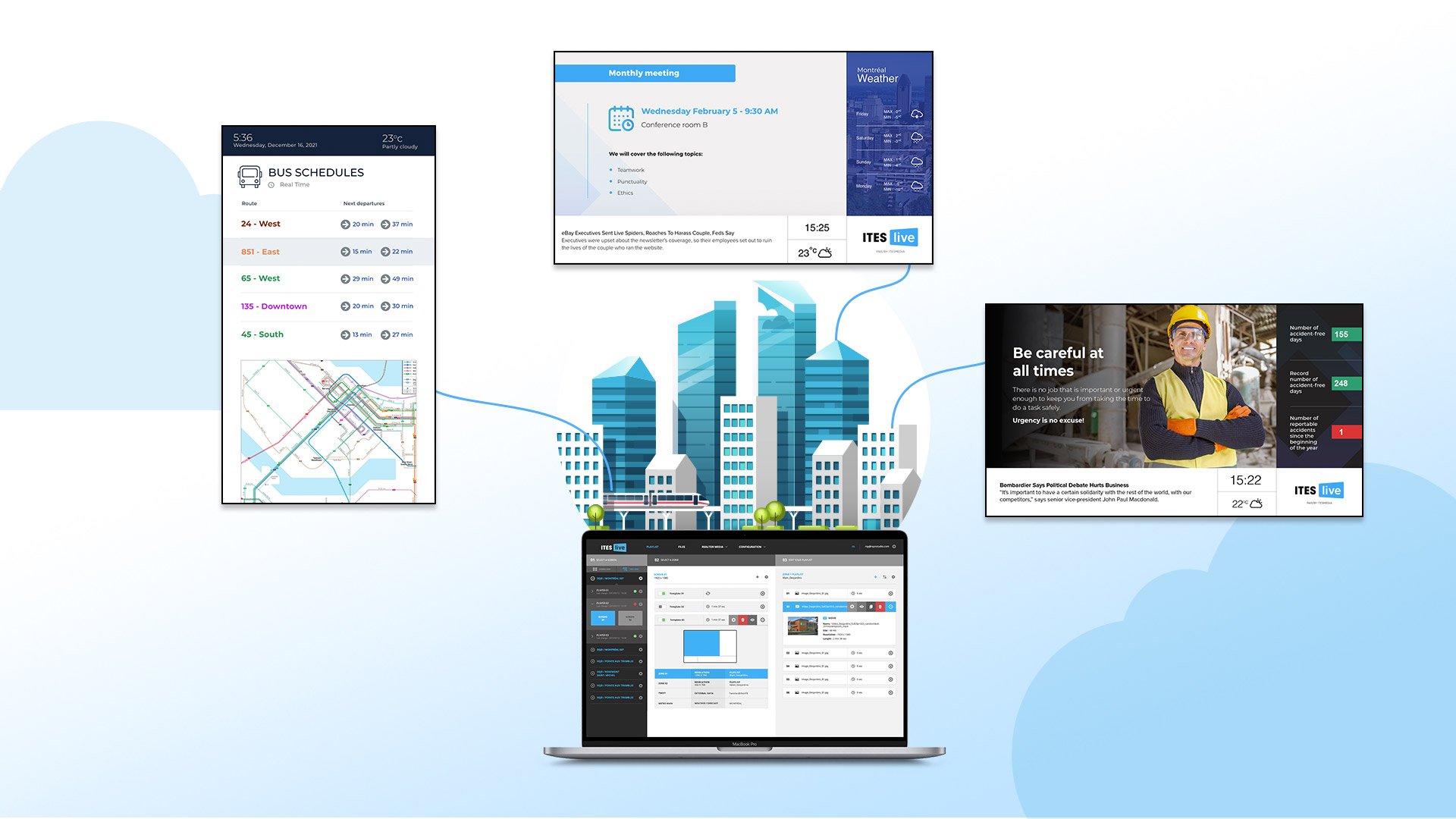
In a reception area or waiting room, visitors generally have more time to see the screens. You can therefore showcase a corporate video, your services, customer testimonials, organizational news, upcoming events, educational segments, or even the weather forecast.
In offices, cafeterias, and break rooms, digital signage becomes a powerful tool for internal communication. In particular, it allows you to share key performance indicators (KPIs), health and safety statistics, employee work anniversaries, ongoing projects, social events, human resources announcements, training sessions, or team recognition.
Screens installed in hallways, lobbies, or other high-traffic areas should primarily display short, impactful messages, such as important reminders, urgent communications, safety instructions, or one-time announcements.
By tailoring the content to the context, you can significantly improve the effectiveness of your visual communication.
How can you effectively distribute content?
Once your strategy is in place, it’s time to plan content distribution.
Digital signage software allows you to automatically schedule posts based on specific times, days of the week, locations, or groups of screens. This scheduling ensures that each audience receives the information intended for them, without manual intervention.
To keep your audience engaged, it’s recommended to update your content regularly. Screens that always display the same messages eventually go unnoticed.
It’s also best to display simple messages accompanied by high-quality images or videos. Limit the amount of text, use a font large enough to be read from a distance, and make sure the main message can be understood quickly.
Finally, always set a start date and an end date for temporary content. This ensures your digital signage network stays current and prevents outdated messages from being displayed. For example, a Happy Easter greeting or an event announcement should automatically be removed once the relevant date has passed.
Read: Tips for Digital Signage Content Managers
How to Measure the Effectiveness of a Digital Signage Strategy?
A digital signage strategy doesn’t end once the content is displayed. To continuously improve your communications, it’s important to measure the results you achieve.
Performance metrics vary depending on your organization’s objectives. For example, you can track the number of QR code scans, participation rates in an activity, registrations for a training session, changes in OHS metrics, operational performance, or statistics from an internal campaign.
It’s also helpful to gather feedback from employees or visitors to better understand which content captures their attention and which should be improved.
Analyzing these results helps identify which content generates the most engagement, which pieces are meeting their objectives, and which should be improved or replaced. By regularly evaluating the performance of your digital signage network, you can optimize your communications, better meet your audience’s expectations, and maximize the return on investment of your digital signage solution.
What are the best practices for a successful digital signage strategy?
A successful strategy relies first and foremost on content that is useful, simple, and tailored to your audience.
Focus on one main message per screen, use high-quality visuals, and limit the amount of text so the information can be understood in just a few seconds.
Also, be sure to vary your content. Alternate important announcements with company news, statistics, events, videos, recognition messages, or real-time information. This variety helps maintain your audience’s interest and increases the number of people who regularly view the screens.
Finally, update your content frequently. A digital signage network inspires more trust than a screen whose information remains unchanged for several weeks.
The success of a digital signage strategy rests on three essential steps: plan, broadcast, and measure. By clearly defining your objectives, creating content tailored to your audience, scheduling its delivery intelligently, and regularly analyzing the results, you’ll transform your digital signage network into a powerful communication tool. Digital signage is much more than a display medium. It becomes a strategic tool for informing, engaging, and mobilizing your audience while improving communication across your organization.